
Tech info:
Publisher: Activision
Developer: Infinity Ward
Genre: First-Person Shooter
Release Date: Nov 5, 2007
ESRB: MATURE
ESRB Descriptors: Blood and Gore, Intense Violence, Strong Language
System requirements:
Microsoft Windows XP/Vista.
2.4 GHz dual core or better is recommended
1024MB RAM (2048MB for Vista)
3.0 Shader Support recommended.
Nvidia Geforce 7800 or better or ATI Radeon X1800 or better
Overview:
It’s been two years since Infinity Ward dazzled us with their Xbox 360 launch title, Call of Duty 2. Last year Treyarch took over the franchise, at least from a historical WWII standpoint while Infinity Ward locked themselves away in some secluded military bunker and took their epic franchise into more modern times. The result of more than two years of intense game design and a next-gen vision of how online games should really be played has finally arrived. Welcome to Call of Duty 4: Modern Warfare.
With a story ripped straight from today’s headlines, gamers can finally get a small taste of what our boys over in Iraq are likely going through. This is the stuff they won’t be showing you on CNN and Fox News, but you know it’s happening. The single-player story takes place across multiple countries and follows the Marines as well as the British S.A.S. in parallel events that ultimately converge in a joint operation to save the United States from nuclear devastation.
Gameplay:
It would be easy to compare Modern Warfare to other similar games like Rainbow Six and Ghost Recon, and while those franchises share a few common threads, Call of Duty 4 is more of an action oriented title, so rather than focusing on squad tactics and issuing orders, you are merely part of a team, a virtually indestructible team, which means you are only required to kill as many enemies as you can and stay alive.
I was surprised at how little focus was put on the interpersonal story. I really didn’t come to care for my teammates. They were merely distractions to draw enemy fire so I could advance to the  next checkpoint. There is even a quote during one of the load screens that says something like, “It’s good to be part of a team. It gives the enemy somebody else to shoot at”, which was exactly how I felt about my squad. Call me heartless, but knowing that they couldn’t die and that 2-4 well placed shots would have me restarting from the last checkpoint tends to negate any feelings of loyalty.
The game kicks off with the traditional training scenario where you learn how to target, fire, and even assassinate some fresh fruit. Then you get to run a short training simulation, a wooden mock-up of a cargo ship you will be invading shortly. This is a timed event where you rush to five waypoints and shoot pop-up targets, flash bang rooms, and sprint to the finish. Your performance on this simulation will result in the game "suggesting" a suitable difficulty level for the rest of the campaign mode. My advice, especially if you are a veteran of the previous Call of Duty games is to ignore their recommendation and play on Hardened. This will offer a challenge worthy of your skills without the frustration of dying every 20-30 seconds in Veteran mode.
The scene shifts to you, aboard a chopper as you fly in low and rappel down to the deck of a giant cargo vessel during a terrible storm. You and your team will move through the ship, taking down anyone and everyone, even a staggering drunk and crewmen asleep in their bunks. You’ll make your way along the length of the swaying ship, trying to spot enemy lookouts through the blinding rain, taking cover in empty containers, and advancing to the rear section of the ship and down into the cargo hold. After a few enemy encounters in the cargo area your team will uncover a hidden nuclear warhead, but before you can do anything two bogies have been spotted headed to your location.
You grab the clipboard with some valuable intel and start to retreat back to the chopper when the ship is rocked with a fiery blast and you are knocked to the deck. The next 30 seconds is perhaps some of the most exciting cinematic moments of actual gameplay you’ve experience this year, as you rush along catwalks, through collapsing passages, and scramble across the slippery deck of the tilting ship, making a final daring leap to your chopper. Fade to black and roll credits. Yep, that all happens before the game even really starts - how James Bond is that?
The opening credit sequence is quite brilliant. You are put into the body of the deposed president, tossed in a car and driven to your execution. Along the way you have full control of looking around, and watching the citizens and militia running around shooting and looting is pretty awesome. It might take you several car rides to see everything that is going on during this lengthy sequence. The single-player campaign in Call of Duty 4 could be considered short by some, but I found it to be the perfect length and offered an excellent progression of difficulty. Spread across three acts and 16 chapters, you’ll get to experience some extremely intense and exciting combat as both a Marine and S.A.S. operative. The battles really heat up when you get into the urban combat arenas where enemies are lurking on every rooftop and balcony, and sniping from the smallest hole in the wall.
While Call of Duty 4 reinvents itself from a presentation and timeline standpoint it fails to truly bring anything new to the table in terms of gameplay. Vehicles, which were always a fun diversion in previous titles whether you were riding a jeep or moving from numerous gun stations on a bomber, are all but missing. There is one insane car chase at the very end of the game, one chopper flyover where you get to shoot at rooftop targets (a unabashed knockoff from GRAW), and an amazing ride in a Spectre AC-130 gunship, but that's it.
In the mission, Death from Above, you play the TV operator onboard an AC-130 in charge of targeting and issuing fire orders at ground targets. You get to pick from three powerful weapons, each with their own zoom level and range of devastation. The 150mm cannon is capable of taking out entire city blocks with a single blast, while the 40mm cannon is powerful enough to take out cars and small buildings without too much collateral damage. The 25mm gatling gun zooms in close and lets you take out individual targets with extreme precision. The entire level is played in black and white, or you can invoke thermal vision and play in white and black (yes, there is a difference). This is easily my second favorite level in the game.
Which obviously leads to my first favorite level, All Ghillied Up, a flashback episode that takes you back 15 years allowing you to tag along with Captain MacMillan as you both head deep into enemy territory to assassinate Imran Zakhaev. The mission takes place in Pripyat, just outside of Chernobyl, and just after the nuclear accident that happened around that time. Expect a lot of abandoned cities and pockets of radiation you’ll need to avoid, so listen to your Geiger counter.
This mission is all about stealth and either avoiding enemy contact or taking out enemies in such a way that nobody is alerted. You are virtually undetectable in your ghillie suit, a full-body outfit that eliminates all straight and curved lines of your profile as you sneak through the underbrush. There is one butt-clinching moment where you and MacMillan are laying in a field of tall grass as tanks and soldiers march toward you and right past (if you are lucky). Perhaps even more tense than that is a makeshift enemy camp inside a maze of cargo containers. You must sneak in and avoid four soldiers clustered around a barrel with a laptop to get some enemy intel. One soldier is asleep, tipped back in a chair, one is on patrol, and two others are nearby enjoying a smoke.
Old staples like looking down the barrel for improved accuracy as well as tossing grenades back at the enemy have returned as well as a few new elements. Dogs join the cast of enemies, but they only appear 3-4 times in the game and they aren’t that hard to kill. If one does knock you down you simply have to push the melee attack to snap its neck before it rips your throat out. I think the dogs would have been better implemented as warnings rather than soldiers. It would have been extremely cool to have dogs in the All Ghillied Up mission and then have to worry about staying downwind of them.
The other major new feature that significantly “impacts” the gameplay is realistic ballistics. Bullets have now been granted their right to travel through wood, brick, and even thin metal, effectively reducing your ability to hide behind anything for too long. This feature alone keeps the game, as well as yourself, moving quickly through the levels, but it also gives you the advantage to take down enemies hiding behind a door or a wooden crate.
Weapons have been modernized, but other than the models and shapes changing, the way you play the game remains unchanged. You still have your shotgun for up-close spread damage, long-range weapons, flash, frag, and smoke (far fewer smoke grenades in this game), and the occasional mounted turret, the best of which is inside a crashed chopper. You actually have to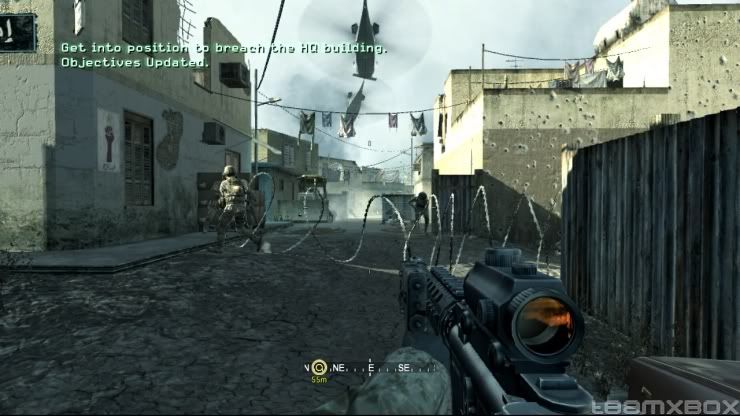 spin-up this weapon with the left trigger before you can fire with the right. The Javelin is by far the coolest weapon in the game, launching a tank-busting missile high into the sky before it streaks down to decimate its target.
Before I end up recounting the entire game and spoiling all the good parts lets move on to Arcade mode and multiplayer. Once you finish the campaign you’ll unlock Arcade mode, which allows you to play the game as an arcade experience with a fixed number of lives and scores for enemy kills. But multiplayer is where Call of Duty 4 really shines and ultimately destroys Halo 3 and any other multiplayer combat game currently out there.
The multiplayer experience is so massive that Infinity Ward had to lock most of it down and then trickle it back out as incremental rewards for ranking up through online play. Modern Warfare is a class-based experience. At first you’ll have to choose from the few pre-configured classes, but when you have ranked up enough you’ll be able to use the Create-a-Class to customize any of five unique classes, each with your own weapons, attachments, and perks. You can have a class for urban levels, one for outdoor woodsy levels, a Rambo class, a stealth/sniper class, or anything you want. You can select your class before a match and change classes during a match. This change will take effect when you respawn.
Perks are special abilities you will earn and you can assign up to three per class. These range 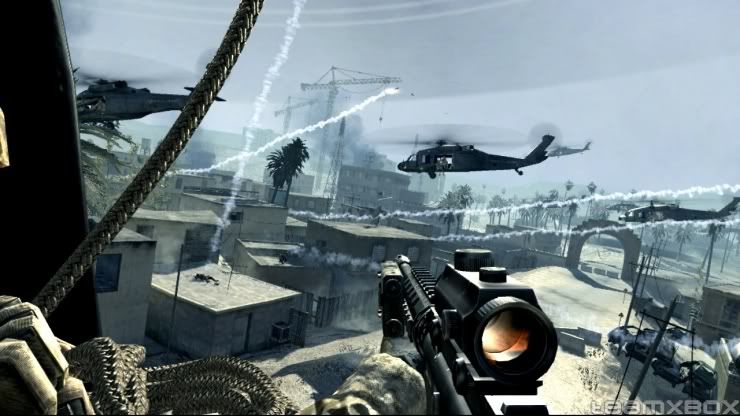 from anything from bonus weapons (RPG, C4, Claymore) to personal enhancements (increased health, faster reloads, invisible to radar), and combat enhancements (improved accuracy, steady aim, deep bullet penetration). There are some really fun perks like Last Stand where you get 15 seconds after being shot to use your knife or pistol to take down anyone nearby, or Martyrdom where you drop a live grenade when you die.
Perhaps the coolest perk is Eavesdrop that allows you to hear enemy conversations. Normally, during online play you only hear your own teammates, which allows you to coordinate and strategize. With Eavesdrop activated you are now privy to enemy tactics and can relay that info to your own guys. Of course this only works if you are playing with others sophisticated enough to be using team tactics in the first place.
One of the more innovative concepts in multiplayer are the Kill Streak bonuses awarded for consecutive kills. If you can kill 3 enemies you can call in a UAV for a radar sweep that will reveal enemy locations (for anyone not using the UAV Jammer perk). Killing 5 enemies will bring in an airstrike allowing you to pick the target on an overhead map of the level and obliterate it. And killing 7 enemies summons the attack chopper that will swoop in and send enemies running for cover and their rocket launchers.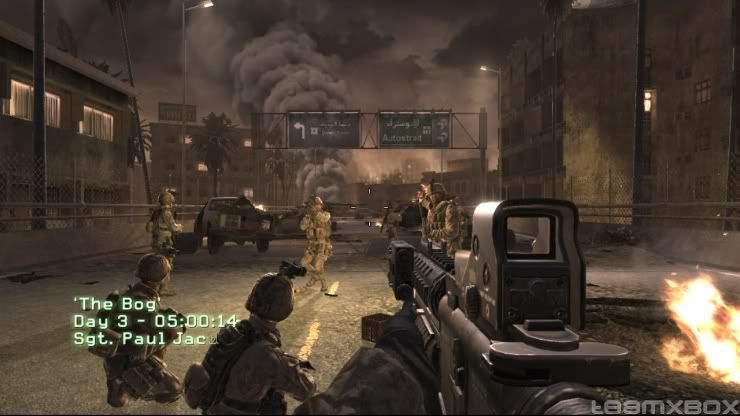
There are 55 levels you can rank-up through and then you have the option to enter Prestige mode, which basically restarts you back at the first level with a clean slate and a special icon to indicate just how badass you really are. There are 10 levels of prestige, effectively giving you 550 levels of ranking. When the guys at Infinity Ward told me there was more than 300 hours of multiplayer gameplay in Call of Duty 4 I was skeptical, but now I think that estimate may be too low.
To keep you motivated during those 300+ hours of gameplay are numerous weapons and skill challenges – ten sets in all. There are only a few at first but as you acquire more weapons and rank up, more will unlock. For instance, the Assault Rifle challenge is broken down into all four assault rifle classes with six challenges per weapons. Now mirror that for SMG, LMG, Shotgun, and Sniper then tack on Boot Camp, Operations, Killer, and Humiliation challenges and you have hundreds of objectives that will take you months to complete.
There are numerous multiplayer modes, but even these are limited until you earn a high enough rank. Newcomers will head for Team DM or standard Deathmatch games, but there is great fun to be had in Domination, Ground War, Sabotage, Headquarters, Search and Destroy, Team Objective, Team Hardcore, Old School, and Oldcore. The “core” games eliminate the HUD and activate friendly fire, while the “old” games remove the classes and put everyone on the same level.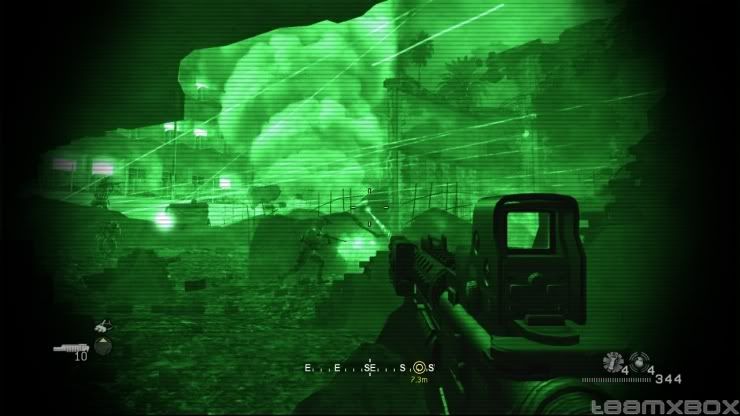 Regardless of the type of game you are playing, Call of Duty 4 is a fantastic experience with support for up to 18 soldiers over the PlayStation Network and your broadband connection. The game does a good job of matching you with similarly skilled players. Stages are pre-selected and rotated but you can always vote to skip a level you don’t like – majority rules.
To wrap up this section, I’m compelled to complain about the weak 7-page manual (or should I say “insert”) that came with the game. Obviously, somebody is trying to force you to buy the strategy guide, and you should, if you want to have any type of competitive edge in the online arena, not to mention any chance in hell of finding the hidden intel in the solo campaign.
I must also complain about the Mature rating. Personally, I don’t care because I’m old enough, but I think I speak for a few million pre-17 gamers out there with strict parents who won’t be allowed to play this game when I say, “why is this game rated M”? There is virtually no blood (or gore) to speak of, and the death and carnage is no worse than any of the WWII Call of Duty games that have come before this. And with the exception of a few “shits, hells” and “wankers” there is no bad language to speak of. I can only assume that the ESRB is more forgiving when it comes to historical war shooters than those set in modern times. It’s a sad commentary considering a lot of those pre-17 gamers will likely be enlisting in a year or two to do this for real.
The PC is virtually identical to the 360 and PS3 versions of the game. The obvious exception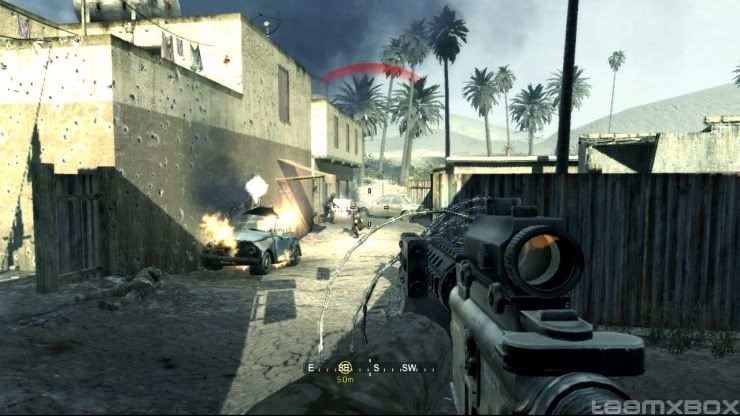 would be the arguably improved controls, but after playing this game on console I found the mouse and keyboard were almost "too precise" and made the game too easy a lot of the time. Multiplayer offers the added support for up to 32 players creating the opportunity for much larger battles than the 18-player cap on console.
Graphics:
Call of Duty has always impressed me with its amazing visuals but nothing could really prepare me for the absolute photo-realism of what I was seeing while playing Modern Warfare. Sure, there are moments where the game sinks into videogame land, but for the most part you’d be hard pressed to tell you aren’t watching footage from some CNN guy embedded with the troops.
The animations and character modeling are ultra-realistic, and you’ll see your team executing coordinated CQB moves right from the military handbook. They breach doors, cover corners, and provide cover fire for advancement and even reloads. The details on the models goes right down to individual gear; grenades on the belt, extra ammo, and some of the best weapon models you’re likely to see without enlisting. There are day and night missions, providing ample opportunity to break out the night vision goggles. These not only turn the view into monochromatic green, but also reveals the laser targeting sights of any weapons in view. It also amplifies the negative effects of an enemy flash bang grenade - gotta love that retina burn.
The urban levels were easily the highlights of the game with multi-tiered structures, narrow alleys, balconies, rooftops, basements, and all sorts of places to take cover. There is one mission where you are escorting a tank down a street lined with enemies on both sides on multiple levels. This level really showcases the visuals and the level design. There is fantastic use of lighting, real-time shadows (even from the light of a TV), weather effects, smoke, fire, and particles for dust and debris. The graphics are quite literally, explosive.
The one thing I didn’t like was my inability to tell friend from foe, but then I realized, that’s probably the way it is in real life which makes me wonder why there isn’t a lot more friendly fire. Not everyone who is an enemy is wearing a turban or a bandana or has a “shoot me” sign on their back. Sometimes the differences are very subtle and really require your utmost attention and reflexes to identify and shoot the proper person. There are a few hints like names and ranks over friendlies and red crosshairs on enemies when firing from the hip.
As far as visual differences between PC and console, they are too few and minimal to even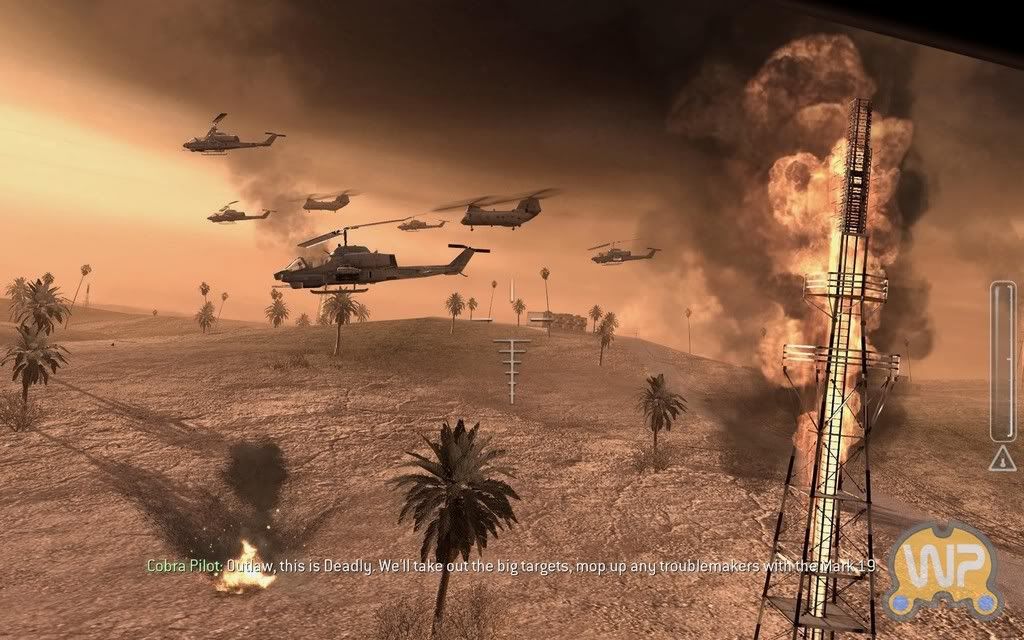 mention and what few variances there are could be considered subjective and easily tweaked with your monitor or in-game brightness and contrast settings. Texture for texture and model for model, the PC and console versions are identical if your PC supports the recommended hardware requirements. You can probably squeak some higher resolutions out of your PC but why risk potential framerate issues when the game looks and performs great 1280x960.
Sound:
When you combine the gorgeous visuals with the epic original score by Stephen Barton and the main theme and music production provided by award-winning composer Harry Gregson-Williams you have something that is not only emotionally immersive, but also incredibly cinematic. While major parts of the game are played in musical silence, there are key parts where music plays a pivotal role in fueling your adrenaline for the battle at hand.
The voice acting goes above and beyond anything we’ve heard in a Call of Duty game. Battle Chatter is back and far more effective than it was before. Your team will call out enemy locations as well as letting you know when they are reloading or advancing to a new area. You’ll also get continual radio updates on where to go and what to do.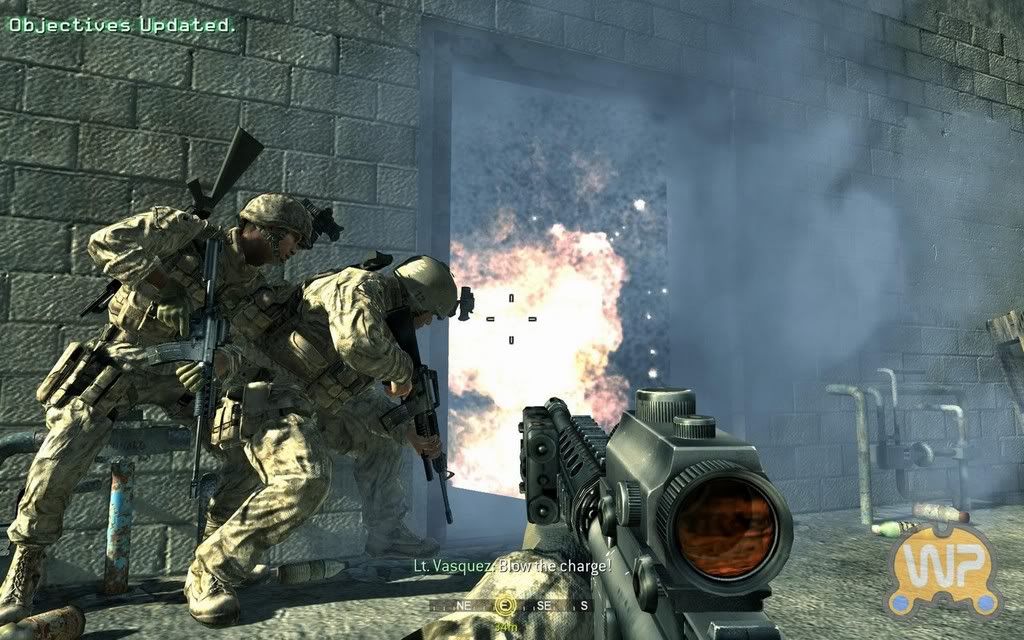
The sound effects are what really sell the war experience. Each and every weapon was digitally sampled and sounds just like its real-life counterpart. They even got the sound of heavy guns and tanks recorded as well as engine noises and explosions and all sorts of environmental sounds like weather, rain, wind, and the sounds of footsteps on a wide variety of surfaces.
The 3D surround mix not only immerses you in the world but also offers its own tactical returns by allowing you to hear enemies sneaking up on your position. This is huge in multiplayer where there is far more sneaking than the solo game. And while the visuals between console and PC are virtually identical, I have to give the nod to the consoles for slightly superior sound. I have an Audigy and a THX 7.1 surround system on my PC, but it can't compete with the Onkyo surround system in the big game room.
Value:
If you are in this for the solo game you’ll likely feel a bit cheated. On Normal mode you can blast your way through the single-player game in 8-10 hours. Hardened bumps that to 12-16 hours and Veteran will likely hit the 18-20 hour mark with a lot of death and checkpoint restarts.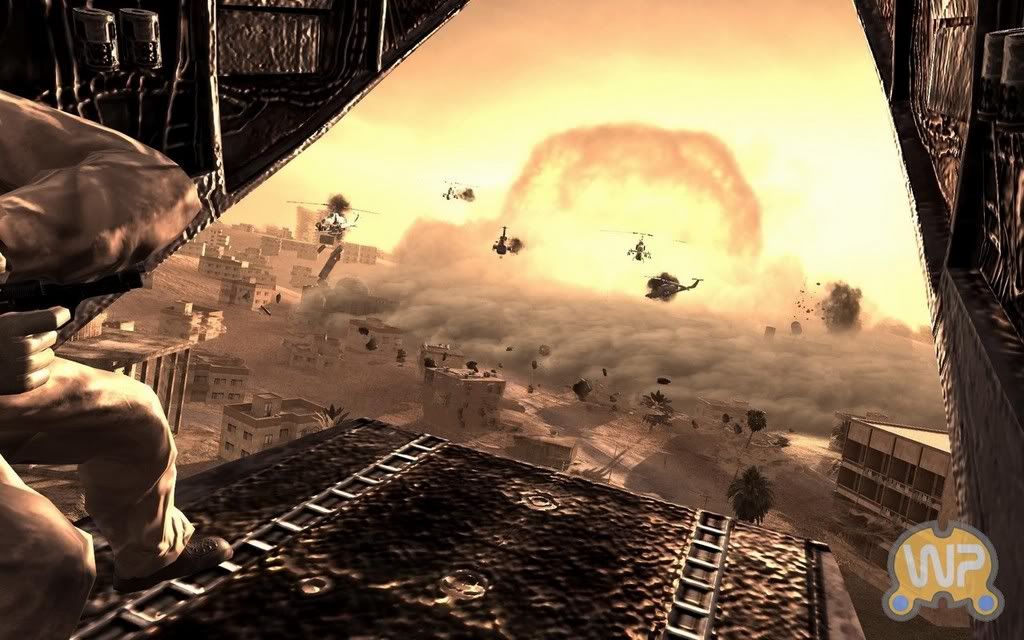
Multiplayer is the obvious focus for this fourth installment of Call of Duty, and to fully exploit every last challenge and rank you can expect to spend anywhere from 200-300 hours, or more. Much like you, the game only gets better the more you play it.
Final:
Call of Duty 4: Modern Combat is easily the best game in the history of the franchise, at least from a technical standpoint. I didn’t find it nearly as immersive or personally rewarding as I did the previous WWII games where I actually came away having learned something, but that is the risk you take when you abandon history and delve into fiction. Perhaps, someday, when the current events in Iraq are declassified, Infinity Ward can do something a bit more relevant with the genre.
Even so, Modern Combat is just about as perfect a game as you can get. It falls short of total perfection only because it really doesn’t evolve the FPS genre in any significant way – not that I know what that might be, but I’d know it if I saw it. It’s a must-own, must-play game for anyone (screw the ESRB) who owns a next-gen console or high-end PC.
Showing posts with label Nitendo DS. Show all posts
Showing posts with label Nitendo DS. Show all posts
Wednesday, November 28, 2007
Call of Duty 4: Modern Warfare

Sunday, November 25, 2007
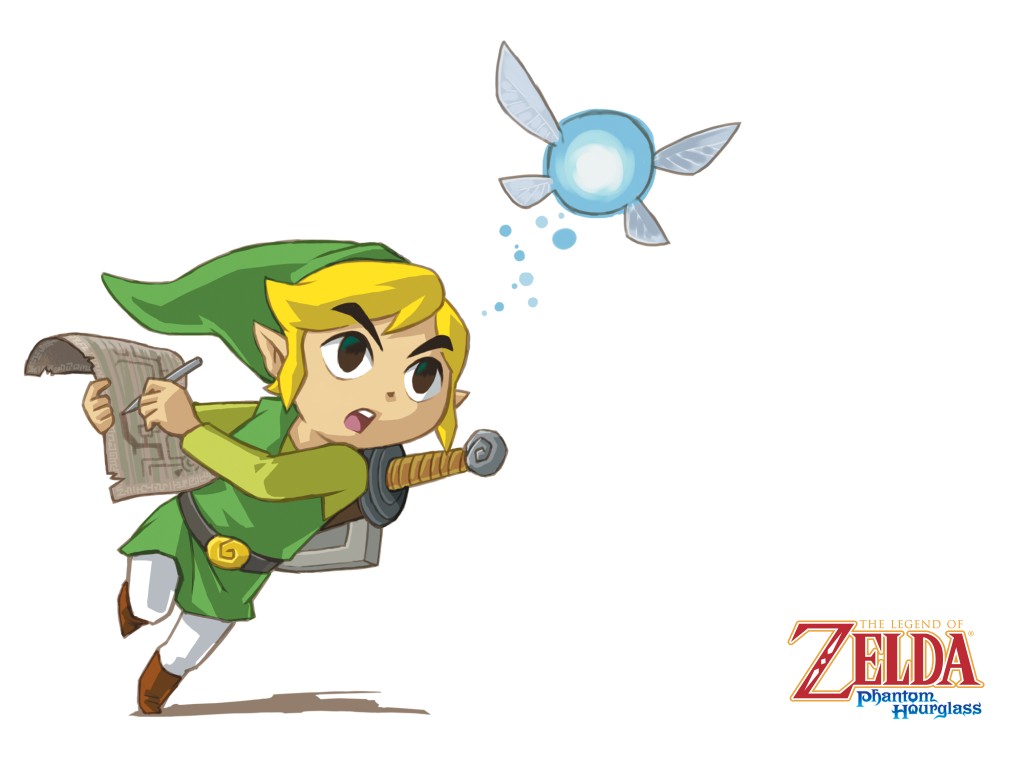
The Legend of Zelda: Phantom Hourglass
Tech Info:
Publisher: Nintendo
Developer: Nintendo
Genre: Action-RPG Adventure
Release Date: Oct 1, 2007
ESRB: EVERYONE
Story:
Phantom Hourglass picks up where Wind Waker left off. After Link and Tetra - as princess Zelda - defeated Gannon, they and their pirate friends went off in search of adventure on the high seas.While exploring new waters, they come upon the Ghost Ship, said to steal the life of anything that goes onboard.Tetra, being the spunky gal she is, hops onboard the ship and starts exploring, undaunted by the haunting tales. Soon after boarding, however, she screams and Link, trying to save her, falls into the ocean. When Link wakes up, he finds himself on Mercay Island and quickly befriends the fairy, Ciela, and her grandfatherly caretaker, Oshus. Link tells the man of his lost friend and is directed to the Temple of the Ocean King, where he encounters a man named Linebeck, who is currently trapped in the temple. Link quickly frees the man, gets the sea chart for the region, and joins Linebeck to chase after the Ghost Ship. Adventure ensues.
Now, anyone can tell that this is not a particularly original story. Link is once again saving the princess from the forces of evil. Yet the telling of this tale is done very well. From the paper cutouts of the introduction to the funny faces and illustrative gestures made by Link and Linebeck, Phantom Hourglass delivers the same old same old with a fresh face, great humor, and excellent characterization. And say what you will of the cartoony style, it lends itself very well to storytelling through pantomime.
Gameplay:
By far, this is Phantom Hourglass's greatest feature. It has been a while since I've played anything as creatively designed as Phantom Hourglass. From the start, you get the feeling that this is something different. I mean, you're so used to controlling Link with a d-pad, and now you're forced to rely completely on the stylus for almost everything. And yet, I found that the little snippets of stylus-dependent interactions in previous DS games had adequately prepared me for the maneuvers I had to perform to get Link to walk, run, toss items, roll, attack and fish. Control isn't perfect, but we'll get to that later. For those of you who haven't played Wind Waker, you take Link from island to island via a ship and fight enemies, open chests, and solve puzzles in real time.
There's not much new here, except for the Temple of the Ocean King, a multi-level dungeon with some interesting challenges. The first major challenge is the time limit. The Temple constantly drains your health unless you have the Phantom Hourglass, which you acquire early in the game. This bauble allows you to negate the effects of the temple for as long as the sand remains. Killing bosses and finding sunken chests nets you more sand, extending your time. Managing your time as you go down is important, and since you will be revisiting the labyrinth multiple times, you may find shortcuts as you gain new items.
The other challenge is the Phantoms, huge spectral warriors that roam the halls of the Temple. Phantoms cannot be killed until the end of the game, so you must avoid them at all costs. If spotted, you must flee to a safe zone which hides you from them and stops the timer. Both challenges combine to make the Temple a unique experience, and while it was at times aggrivating, overall it was tolerable.
As far as the rest of the game's play goes, much like the story, Phantom Hourglass takes the old and makes it fresh with innovative design. The two best examples would have to be the puzzles and the boss fights.
The puzzles in Phantom Hourglass aren't particularly hard, but they are creative, requiring you to use the DS in ways that you naturally wouldn't think of. Everything from the microphone to the suspend feature are required as solutions to the puzzles in this game. Being able to write on the map is a godsend, as well as an innovative way to keep track of clues and find the location of hidden treasure. And while the solutions the puzzles were usually apparent after a bit of thinking, they still remained challenging enough to keep me interested.
The other aspect of gameplay that really stood out was the boss fights. It shouldn't come as a surprise that Zelda series bosses would have different and creative weaknesses, but Phantom Hourglass' excellent use of the DS hardware added a whole new dimension. Frequent use of the dual screens and imaginative use of items is key to defeating bosses, some of which present a real conundrum until you finally reach an epiphany and then proceed to whoop arse.
There is also multi-player included via wi-fi, but I didn't get into it, so I cannot comment. Aside from that, though, Ninendo has done a great job in making a truly novel playing experience.
Graphics:
The DS is no slouch at pushing polygons, and Phantom Hourglass proves it. With graphics that approach what you'd expect from a late-era N64 or early-era PS2 game, you won't want for quality. All of the characters are rendered with enough polygons to move fluidly and not look blocky. A great attempt is made at shading too; both cel shading for the characters and lighting are done well, lending a cartoony feel that still manages to be high-quality. The only place that the visuals get dicey is during the cutscenes; whenever there is a close-up on an island or model, the detail on the textures breaks down and the presentation degrades a bit, but it's a minor point.
The best part about the graphics, though, are the character designs. For those of you who can recall the release of Wind Waker, it got harshly criticized for the characters' cartoony looks. I loved them, however, and after the ugliness that was Ocarina of Time's characters, it was nice to have a new, less hideously repulsive style. Phantom Hourglass delivers more of the same, and the result is characters who are expressive and funny. Kudos!
Sound:
I don't care what people say, I've never been a big fan of Zelda music, and after Twilight Princess' awful midi score, I didn't exactly want to hear more. Fortunately, Phantom Hourglass has a decent soundtrack, and any sound quality issues can be blamed on the DS's tiny speakers rather than a lack of quality sequencing. From epic sailing themes to the ominous dungeon tunes, Phantom Hourglass's soundtrack will not offend, and may even delight, but at the very least you can expect to get fitting music all around.
That being said, sound effects in Phantom Hourglass are pretty well done. The echoes in caves and cavernous dungeons are a nice touch, as are Link's shouts and grunts, as they really give the lad personality despite him not actually delivering any lines.
Control:
With a game like Phantom Hourglass you'd think accurate, dead-on control is a MUST. Strangely, you'd be wrong. Phantom Hourglass, despite requiring all movement and all action be controlled by the stylus, does not do a perfect or even near-perfect job making the stylus respond the way you want it to. Rolling, in particular - but also sword swings and aiming - are more difficult than I had expected them to be and are definitely not precise. The good thing is that Nintendo likely realized this and made the game a lot more forgiving than it would be otherwise. While it is somewhat of a cop-out, toning down the difficulty level to accommodate less-than-perfect control was still acceptable, considering how fun the rest of the game was.
Over:
Legend of Zelda: Phantom Hourglass was a fun game. On top of that, it was creative and used the DS in ways that really showed off the potential of the system. While it may not be the best game you'll play this year, it certainly will make you appreciate the creativity that went into its design and the solid product that was the result. I wholeheartedly advise you to play this game, if for no other reason than see that a game can be fun while still managing to use a system hardware in creative ways.
Publisher: Nintendo
Developer: Nintendo
Genre: Action-RPG Adventure
Release Date: Oct 1, 2007
ESRB: EVERYONE
Story:
Phantom Hourglass picks up where Wind Waker left off. After Link and Tetra - as princess Zelda - defeated Gannon, they and their pirate friends went off in search of adventure on the high seas.While exploring new waters, they come upon the Ghost Ship, said to steal the life of anything that goes onboard.Tetra, being the spunky gal she is, hops onboard the ship and starts exploring, undaunted by the haunting tales. Soon after boarding, however, she screams and
Link, trying to save her, falls into the ocean. When Link wakes up, he finds himself on Mercay Island and quickly befriends the fairy, Ciela, and her grandfatherly caretaker, Oshus. Link tells the man of his lost friend and is directed to the Temple of the Ocean King, where he encounters a man named Linebeck, who is currently trapped in the temple. Link quickly frees the man, gets the sea chart for the region, and joins Linebeck to chase after the Ghost Ship. Adventure ensues.Now, anyone can tell that this is not a particularly original story. Link is once again saving the princess from the forces of evil. Yet the telling of this tale is done very well. From the paper cutouts of the introduction to the funny faces and illustrative gestures made by Link and Linebeck, Phantom Hourglass delivers the same old same old with a fresh face, great humor, and excellent characterization. And say what you will of the cartoony style, it lends itself very well to storytelling through pantomime.
Gameplay:
By far, this is Phantom Hourglass's greatest feature. It has been a while since I've played anything as creatively designed as Phantom Hourglass. From the start, you get the feeling that this is something different. I mean, you're so used to controlling Link with a d-pad, and now you're forced to rely completely on the stylus for almost everything. And yet, I found that the little snippets of stylus-dependent interactions in previous DS games had adequately prepared me for the maneuvers I had to perform to get Link to walk, run, toss items, roll, attack and fish. Control isn't perfect, but we'll get to that later. For those of you who haven't played Wind Waker, you take Link from island to island via a ship and fight enemies, open chests, and solve puzzles in real time.
There's not much new here, except for the Temple of the Ocean King, a multi-level dungeon with some interesting challenges. The first major challenge is the time limit. The Temple
constantly drains your health unless you have the Phantom Hourglass, which you acquire early in the game. This bauble allows you to negate the effects of the temple for as long as the sand remains. Killing bosses and finding sunken chests nets you more sand, extending your time. Managing your time as you go down is important, and since you will be revisiting the labyrinth multiple times, you may find shortcuts as you gain new items.The other challenge is the Phantoms, huge spectral warriors that roam the halls of the Temple. Phantoms cannot be killed until the end of the game, so you must avoid them at all costs. If spotted, you must flee to a safe zone which hides you from them and stops the timer. Both challenges combine to make the Temple a unique experience, and while it was at times aggrivating, overall it was tolerable.
As far as the rest of the game's play goes, much like the story, Phantom Hourglass takes the old and makes it fresh with innovative design. The two best examples would have to be the puzzles and the boss fights.
The puzzles in Phantom Hourglass aren't particularly hard, but they are creative, requiring you to use the DS in ways that you naturally wouldn't think of. Everything from the microphone to the suspend feature are required as solutions to the puzzles in this game. Being able to write on the map is a godsend, as well as an innovative way to keep track of clues and find the location of hidden treasure. And while the solutions the puzzles were usually apparent after a bit of thinking, they still remained challenging enough to keep me interested.
The other aspect of gameplay that really stood out was the boss fights. It shouldn't come as a surprise that Zelda series bosses would have different and creative weaknesses, but Phantom Hourglass' excellent use of the DS hardware added a whole new dimension. Frequent use of the dual screens and imaginative use of items is key to defeating bosses, some of which present a real conundrum until you finally reach an epiphany and then proceed to whoop arse.
There is also multi-player included via wi-fi, but I didn't get into it, so I cannot comment. Aside from that, though, Ninendo has done a great job in making a truly novel playing experience.
Graphics:
The DS is no slouch at pushing polygons, and Phantom Hourglass proves it. With graphics that approach what you'd expect from a late-era N64 or early-era PS2 game, you won't want for quality. All of the characters are rendered with enough polygons to move fluidly and not look blocky. A great attempt is made at shading too; both cel shading for the characters and lighting are done well, lending a cartoony feel that still manages to be high-quality. The only place that the visuals get dicey is during the cutscenes; whenever there is a close-up on an island or model, the detail on the textures breaks down and the presentation degrades a bit, but it's a minor point.
The best part about the graphics, though, are the character designs. For those of you who can recall the release of Wind Waker, it got harshly criticized for the characters' cartoony looks. I loved them, however, and after the ugliness that was Ocarina of Time's characters, it was nice to have a new, less hideously repulsive style. Phantom Hourglass delivers more of the same, and the result is characters who are expressive and funny. Kudos!
Sound:
I don't care what people say, I've never been a big fan of Zelda music, and after Twilight Princess' awful midi score, I didn't exactly want to hear more. Fortunately, Phantom Hourglass has a decent soundtrack, and any sound quality issues can be blamed on the DS's tiny speakers rather than a lack of quality sequencing. From epic sailing themes to the ominous dungeon tunes, Phantom Hourglass's soundtrack will not offend, and may even delight, but at the very least you can expect to get fitting music all around.
That being said, sound effects in Phantom Hourglass are pretty well done. The echoes in caves and cavernous dungeons are a nice touch, as are Link's shouts and grunts, as they really give the lad personality despite him not actually delivering any lines.
Control:
With a game like Phantom Hourglass you'd think accurate, dead-on control is a MUST. Strangely, you'd be wrong. Phantom Hourglass, despite requiring all movement and all action be controlled by the stylus, does not do a perfect or even near-perfect job making the stylus respond the way you want it to. Rolling, in particular - but also sword swings and aiming - are more difficult than I had expected them to be and are definitely not precise. The good thing is that Nintendo likely realized this and made the game a lot more forgiving than it would be otherwise. While it is somewhat of a cop-out, toning down the difficulty level to accommodate less-than-perfect control was still acceptable, considering how fun the rest of the game was.
Over:
Legend of Zelda: Phantom Hourglass was a fun game. On top of that, it was creative and used the DS in ways that really showed off the potential of the system. While it may not be the best game you'll play this year, it certainly will make you appreciate the creativity that went into its design and the solid product that was the result. I wholeheartedly advise you to play this game, if for no other reason than see that a game can be fun while still managing to use a system hardware in creative ways.
Friday, November 16, 2007
Need for Speed ProStreet
Need for Speed , one of most hottest Racing game series ,the newest of this series ProStreet is available ,good or bad ? Let's watch and feel .
Released : Nov/13-15
Follow this link for download

Your car is now ready !
 This Zone Details >>>
Tuesday, November 13, 2007
Assassin's Creed (Movie Review)
Best news :
Today , November 13 ,2007 Assassin's Creed is Released
Yes , this is Review of Assassin's Creed (HD quality) ,Let's see what we have with one of hottest game in this year !!!
>>>Download<<<
Copy this link location to your download manager and download it .
Or come to this page for download
Be quiet , The Assassin's now coming!
 This Zone Details >>>
Today , November 13 ,2007 Assassin's Creed is Released
Yes , this is Review of Assassin's Creed (HD quality) ,Let's see what we have with one of hottest game in this year !!!
>>>Download<<<
Copy this link location to your download manager and download it .
Or come to this page for download
Be quiet , The Assassin's now coming!
This Zone Details >>>
Subscribe to:
Posts (Atom)
