You want to be the one who can control time ? Let play Time Shift ...
Released : October 30, 2007
For download

Be careful with your Time !!!

This Zone Details >>>

Tech info:
Publisher: Activision
Developer: Infinity Ward
Genre: First-Person Shooter
Release Date: Nov 5, 2007
ESRB: MATURE
ESRB Descriptors: Blood and Gore, Intense Violence, Strong Language
System requirements:
Microsoft Windows XP/Vista.
2.4 GHz dual core or better is recommended
1024MB RAM (2048MB for Vista)
3.0 Shader Support recommended.
Nvidia Geforce 7800 or better or ATI Radeon X1800 or better
Overview:
It’s been two years since Infinity Ward dazzled us with their Xbox 360 launch title, Call of Duty 2. Last year Treyarch took over the franchise, at least from a historical WWII standpoint while Infinity Ward locked themselves away in some secluded military bunker and took their epic franchise into more modern times. The result of more than two years of intense game design and a next-gen vision of how online games should really be played has finally arrived. Welcome to Call of Duty 4: Modern Warfare.
With a story ripped straight from today’s headlines, gamers can finally get a small taste of what our boys over in Iraq are likely going through. This is the stuff they won’t be showing you on CNN and Fox News, but you know it’s happening. The single-player story takes place across multiple countries and follows the Marines as well as the British S.A.S. in parallel events that ultimately converge in a joint operation to save the United States from nuclear devastation.
Gameplay:
It would be easy to compare Modern Warfare to other similar games like Rainbow Six and Ghost Recon, and while those franchises share a few common threads, Call of Duty 4 is more of an action oriented title, so rather than focusing on squad tactics and issuing orders, you are merely part of a team, a virtually indestructible team, which means you are only required to kill as many enemies as you can and stay alive.
I was surprised at how little focus was put on the interpersonal story. I really didn’t come to care for my teammates. They were merely distractions to draw enemy fire so I could advance to the  next checkpoint. There is even a quote during one of the load screens that says something like, “It’s good to be part of a team. It gives the enemy somebody else to shoot at”, which was exactly how I felt about my squad. Call me heartless, but knowing that they couldn’t die and that 2-4 well placed shots would have me restarting from the last checkpoint tends to negate any feelings of loyalty.
The game kicks off with the traditional training scenario where you learn how to target, fire, and even assassinate some fresh fruit. Then you get to run a short training simulation, a wooden mock-up of a cargo ship you will be invading shortly. This is a timed event where you rush to five waypoints and shoot pop-up targets, flash bang rooms, and sprint to the finish. Your performance on this simulation will result in the game "suggesting" a suitable difficulty level for the rest of the campaign mode. My advice, especially if you are a veteran of the previous Call of Duty games is to ignore their recommendation and play on Hardened. This will offer a challenge worthy of your skills without the frustration of dying every 20-30 seconds in Veteran mode.
The scene shifts to you, aboard a chopper as you fly in low and rappel down to the deck of a giant cargo vessel during a terrible storm. You and your team will move through the ship, taking down anyone and everyone, even a staggering drunk and crewmen asleep in their bunks. You’ll make your way along the length of the swaying ship, trying to spot enemy lookouts through the blinding rain, taking cover in empty containers, and advancing to the rear section of the ship and down into the cargo hold. After a few enemy encounters in the cargo area your team will uncover a hidden nuclear warhead, but before you can do anything two bogies have been spotted headed to your location.
You grab the clipboard with some valuable intel and start to retreat back to the chopper when the ship is rocked with a fiery blast and you are knocked to the deck. The next 30 seconds is perhaps some of the most exciting cinematic moments of actual gameplay you’ve experience this year, as you rush along catwalks, through collapsing passages, and scramble across the slippery deck of the tilting ship, making a final daring leap to your chopper. Fade to black and roll credits. Yep, that all happens before the game even really starts - how James Bond is that?
The opening credit sequence is quite brilliant. You are put into the body of the deposed president, tossed in a car and driven to your execution. Along the way you have full control of looking around, and watching the citizens and militia running around shooting and looting is pretty awesome. It might take you several car rides to see everything that is going on during this lengthy sequence. The single-player campaign in Call of Duty 4 could be considered short by some, but I found it to be the perfect length and offered an excellent progression of difficulty. Spread across three acts and 16 chapters, you’ll get to experience some extremely intense and exciting combat as both a Marine and S.A.S. operative. The battles really heat up when you get into the urban combat arenas where enemies are lurking on every rooftop and balcony, and sniping from the smallest hole in the wall.
While Call of Duty 4 reinvents itself from a presentation and timeline standpoint it fails to truly bring anything new to the table in terms of gameplay. Vehicles, which were always a fun diversion in previous titles whether you were riding a jeep or moving from numerous gun stations on a bomber, are all but missing. There is one insane car chase at the very end of the game, one chopper flyover where you get to shoot at rooftop targets (a unabashed knockoff from GRAW), and an amazing ride in a Spectre AC-130 gunship, but that's it.
In the mission, Death from Above, you play the TV operator onboard an AC-130 in charge of targeting and issuing fire orders at ground targets. You get to pick from three powerful weapons, each with their own zoom level and range of devastation. The 150mm cannon is capable of taking out entire city blocks with a single blast, while the 40mm cannon is powerful enough to take out cars and small buildings without too much collateral damage. The 25mm gatling gun zooms in close and lets you take out individual targets with extreme precision. The entire level is played in black and white, or you can invoke thermal vision and play in white and black (yes, there is a difference). This is easily my second favorite level in the game.
Which obviously leads to my first favorite level, All Ghillied Up, a flashback episode that takes you back 15 years allowing you to tag along with Captain MacMillan as you both head deep into enemy territory to assassinate Imran Zakhaev. The mission takes place in Pripyat, just outside of Chernobyl, and just after the nuclear accident that happened around that time. Expect a lot of abandoned cities and pockets of radiation you’ll need to avoid, so listen to your Geiger counter.
This mission is all about stealth and either avoiding enemy contact or taking out enemies in such a way that nobody is alerted. You are virtually undetectable in your ghillie suit, a full-body outfit that eliminates all straight and curved lines of your profile as you sneak through the underbrush. There is one butt-clinching moment where you and MacMillan are laying in a field of tall grass as tanks and soldiers march toward you and right past (if you are lucky). Perhaps even more tense than that is a makeshift enemy camp inside a maze of cargo containers. You must sneak in and avoid four soldiers clustered around a barrel with a laptop to get some enemy intel. One soldier is asleep, tipped back in a chair, one is on patrol, and two others are nearby enjoying a smoke.
Old staples like looking down the barrel for improved accuracy as well as tossing grenades back at the enemy have returned as well as a few new elements. Dogs join the cast of enemies, but they only appear 3-4 times in the game and they aren’t that hard to kill. If one does knock you down you simply have to push the melee attack to snap its neck before it rips your throat out. I think the dogs would have been better implemented as warnings rather than soldiers. It would have been extremely cool to have dogs in the All Ghillied Up mission and then have to worry about staying downwind of them.
The other major new feature that significantly “impacts” the gameplay is realistic ballistics. Bullets have now been granted their right to travel through wood, brick, and even thin metal, effectively reducing your ability to hide behind anything for too long. This feature alone keeps the game, as well as yourself, moving quickly through the levels, but it also gives you the advantage to take down enemies hiding behind a door or a wooden crate.
Weapons have been modernized, but other than the models and shapes changing, the way you play the game remains unchanged. You still have your shotgun for up-close spread damage, long-range weapons, flash, frag, and smoke (far fewer smoke grenades in this game), and the occasional mounted turret, the best of which is inside a crashed chopper. You actually have to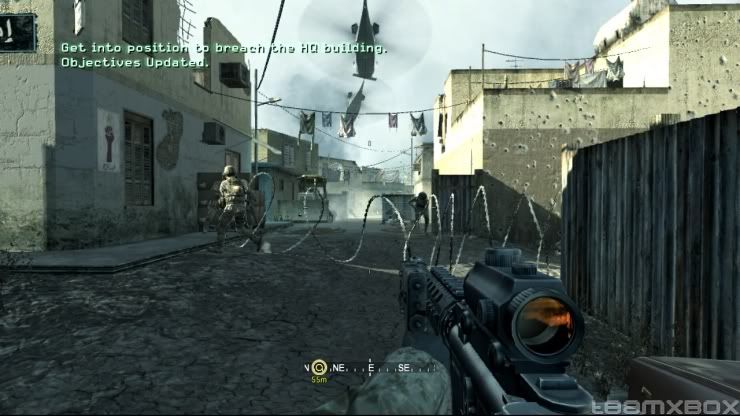 spin-up this weapon with the left trigger before you can fire with the right. The Javelin is by far the coolest weapon in the game, launching a tank-busting missile high into the sky before it streaks down to decimate its target.
Before I end up recounting the entire game and spoiling all the good parts lets move on to Arcade mode and multiplayer. Once you finish the campaign you’ll unlock Arcade mode, which allows you to play the game as an arcade experience with a fixed number of lives and scores for enemy kills. But multiplayer is where Call of Duty 4 really shines and ultimately destroys Halo 3 and any other multiplayer combat game currently out there.
The multiplayer experience is so massive that Infinity Ward had to lock most of it down and then trickle it back out as incremental rewards for ranking up through online play. Modern Warfare is a class-based experience. At first you’ll have to choose from the few pre-configured classes, but when you have ranked up enough you’ll be able to use the Create-a-Class to customize any of five unique classes, each with your own weapons, attachments, and perks. You can have a class for urban levels, one for outdoor woodsy levels, a Rambo class, a stealth/sniper class, or anything you want. You can select your class before a match and change classes during a match. This change will take effect when you respawn.
Perks are special abilities you will earn and you can assign up to three per class. These range 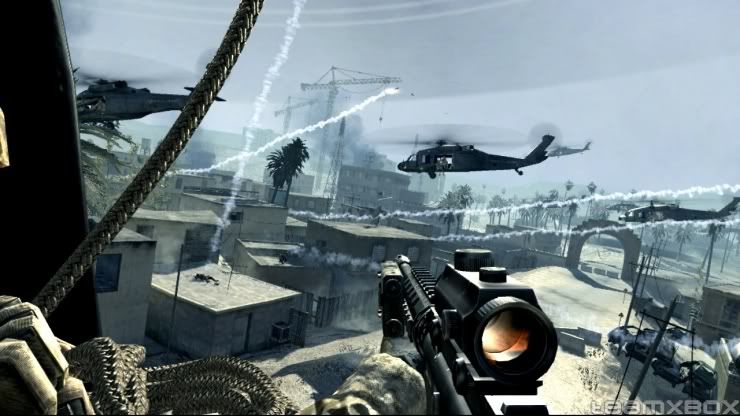 from anything from bonus weapons (RPG, C4, Claymore) to personal enhancements (increased health, faster reloads, invisible to radar), and combat enhancements (improved accuracy, steady aim, deep bullet penetration). There are some really fun perks like Last Stand where you get 15 seconds after being shot to use your knife or pistol to take down anyone nearby, or Martyrdom where you drop a live grenade when you die.
Perhaps the coolest perk is Eavesdrop that allows you to hear enemy conversations. Normally, during online play you only hear your own teammates, which allows you to coordinate and strategize. With Eavesdrop activated you are now privy to enemy tactics and can relay that info to your own guys. Of course this only works if you are playing with others sophisticated enough to be using team tactics in the first place.
One of the more innovative concepts in multiplayer are the Kill Streak bonuses awarded for consecutive kills. If you can kill 3 enemies you can call in a UAV for a radar sweep that will reveal enemy locations (for anyone not using the UAV Jammer perk). Killing 5 enemies will bring in an airstrike allowing you to pick the target on an overhead map of the level and obliterate it. And killing 7 enemies summons the attack chopper that will swoop in and send enemies running for cover and their rocket launchers.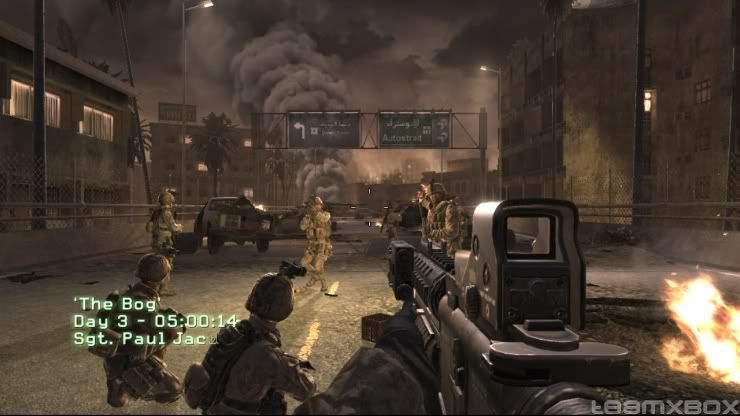
There are 55 levels you can rank-up through and then you have the option to enter Prestige mode, which basically restarts you back at the first level with a clean slate and a special icon to indicate just how badass you really are. There are 10 levels of prestige, effectively giving you 550 levels of ranking. When the guys at Infinity Ward told me there was more than 300 hours of multiplayer gameplay in Call of Duty 4 I was skeptical, but now I think that estimate may be too low.
To keep you motivated during those 300+ hours of gameplay are numerous weapons and skill challenges – ten sets in all. There are only a few at first but as you acquire more weapons and rank up, more will unlock. For instance, the Assault Rifle challenge is broken down into all four assault rifle classes with six challenges per weapons. Now mirror that for SMG, LMG, Shotgun, and Sniper then tack on Boot Camp, Operations, Killer, and Humiliation challenges and you have hundreds of objectives that will take you months to complete.
There are numerous multiplayer modes, but even these are limited until you earn a high enough rank. Newcomers will head for Team DM or standard Deathmatch games, but there is great fun to be had in Domination, Ground War, Sabotage, Headquarters, Search and Destroy, Team Objective, Team Hardcore, Old School, and Oldcore. The “core” games eliminate the HUD and activate friendly fire, while the “old” games remove the classes and put everyone on the same level.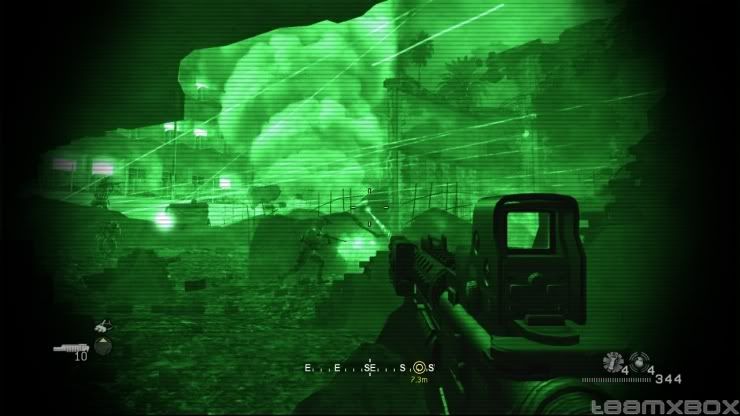 Regardless of the type of game you are playing, Call of Duty 4 is a fantastic experience with support for up to 18 soldiers over the PlayStation Network and your broadband connection. The game does a good job of matching you with similarly skilled players. Stages are pre-selected and rotated but you can always vote to skip a level you don’t like – majority rules.
To wrap up this section, I’m compelled to complain about the weak 7-page manual (or should I say “insert”) that came with the game. Obviously, somebody is trying to force you to buy the strategy guide, and you should, if you want to have any type of competitive edge in the online arena, not to mention any chance in hell of finding the hidden intel in the solo campaign.
I must also complain about the Mature rating. Personally, I don’t care because I’m old enough, but I think I speak for a few million pre-17 gamers out there with strict parents who won’t be allowed to play this game when I say, “why is this game rated M”? There is virtually no blood (or gore) to speak of, and the death and carnage is no worse than any of the WWII Call of Duty games that have come before this. And with the exception of a few “shits, hells” and “wankers” there is no bad language to speak of. I can only assume that the ESRB is more forgiving when it comes to historical war shooters than those set in modern times. It’s a sad commentary considering a lot of those pre-17 gamers will likely be enlisting in a year or two to do this for real.
The PC is virtually identical to the 360 and PS3 versions of the game. The obvious exception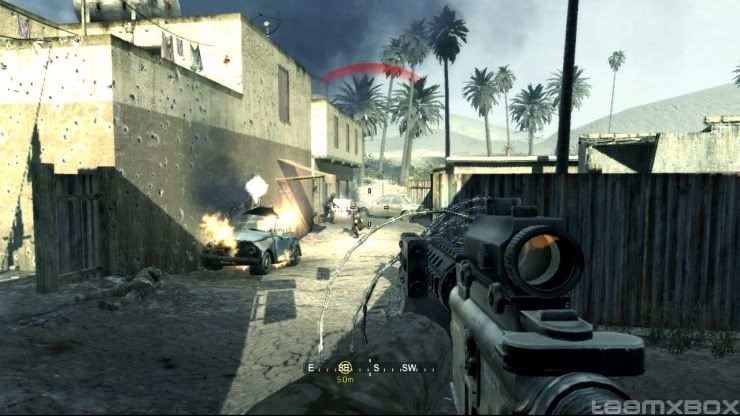 would be the arguably improved controls, but after playing this game on console I found the mouse and keyboard were almost "too precise" and made the game too easy a lot of the time. Multiplayer offers the added support for up to 32 players creating the opportunity for much larger battles than the 18-player cap on console.
Graphics:
Call of Duty has always impressed me with its amazing visuals but nothing could really prepare me for the absolute photo-realism of what I was seeing while playing Modern Warfare. Sure, there are moments where the game sinks into videogame land, but for the most part you’d be hard pressed to tell you aren’t watching footage from some CNN guy embedded with the troops.
The animations and character modeling are ultra-realistic, and you’ll see your team executing coordinated CQB moves right from the military handbook. They breach doors, cover corners, and provide cover fire for advancement and even reloads. The details on the models goes right down to individual gear; grenades on the belt, extra ammo, and some of the best weapon models you’re likely to see without enlisting. There are day and night missions, providing ample opportunity to break out the night vision goggles. These not only turn the view into monochromatic green, but also reveals the laser targeting sights of any weapons in view. It also amplifies the negative effects of an enemy flash bang grenade - gotta love that retina burn.
The urban levels were easily the highlights of the game with multi-tiered structures, narrow alleys, balconies, rooftops, basements, and all sorts of places to take cover. There is one mission where you are escorting a tank down a street lined with enemies on both sides on multiple levels. This level really showcases the visuals and the level design. There is fantastic use of lighting, real-time shadows (even from the light of a TV), weather effects, smoke, fire, and particles for dust and debris. The graphics are quite literally, explosive.
The one thing I didn’t like was my inability to tell friend from foe, but then I realized, that’s probably the way it is in real life which makes me wonder why there isn’t a lot more friendly fire. Not everyone who is an enemy is wearing a turban or a bandana or has a “shoot me” sign on their back. Sometimes the differences are very subtle and really require your utmost attention and reflexes to identify and shoot the proper person. There are a few hints like names and ranks over friendlies and red crosshairs on enemies when firing from the hip.
As far as visual differences between PC and console, they are too few and minimal to even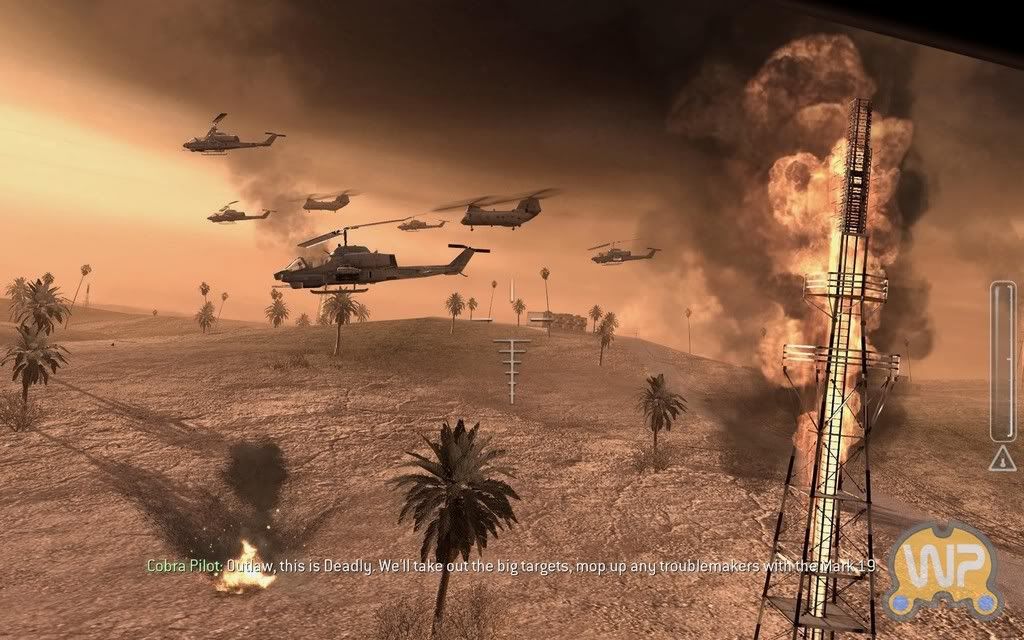 mention and what few variances there are could be considered subjective and easily tweaked with your monitor or in-game brightness and contrast settings. Texture for texture and model for model, the PC and console versions are identical if your PC supports the recommended hardware requirements. You can probably squeak some higher resolutions out of your PC but why risk potential framerate issues when the game looks and performs great 1280x960.
Sound:
When you combine the gorgeous visuals with the epic original score by Stephen Barton and the main theme and music production provided by award-winning composer Harry Gregson-Williams you have something that is not only emotionally immersive, but also incredibly cinematic. While major parts of the game are played in musical silence, there are key parts where music plays a pivotal role in fueling your adrenaline for the battle at hand.
The voice acting goes above and beyond anything we’ve heard in a Call of Duty game. Battle Chatter is back and far more effective than it was before. Your team will call out enemy locations as well as letting you know when they are reloading or advancing to a new area. You’ll also get continual radio updates on where to go and what to do.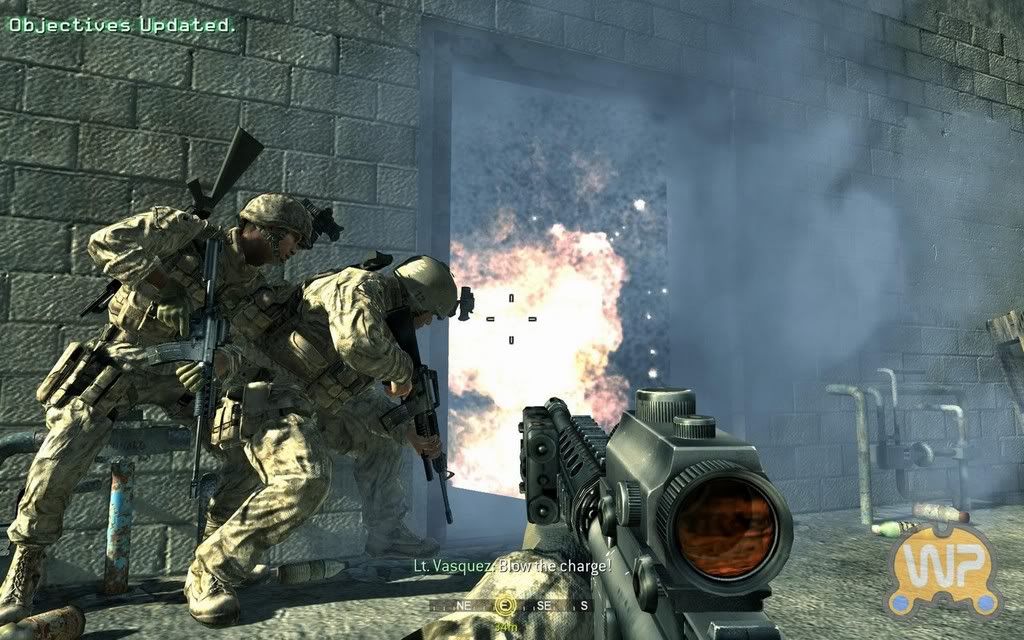
The sound effects are what really sell the war experience. Each and every weapon was digitally sampled and sounds just like its real-life counterpart. They even got the sound of heavy guns and tanks recorded as well as engine noises and explosions and all sorts of environmental sounds like weather, rain, wind, and the sounds of footsteps on a wide variety of surfaces.
The 3D surround mix not only immerses you in the world but also offers its own tactical returns by allowing you to hear enemies sneaking up on your position. This is huge in multiplayer where there is far more sneaking than the solo game. And while the visuals between console and PC are virtually identical, I have to give the nod to the consoles for slightly superior sound. I have an Audigy and a THX 7.1 surround system on my PC, but it can't compete with the Onkyo surround system in the big game room.
Value:
If you are in this for the solo game you’ll likely feel a bit cheated. On Normal mode you can blast your way through the single-player game in 8-10 hours. Hardened bumps that to 12-16 hours and Veteran will likely hit the 18-20 hour mark with a lot of death and checkpoint restarts.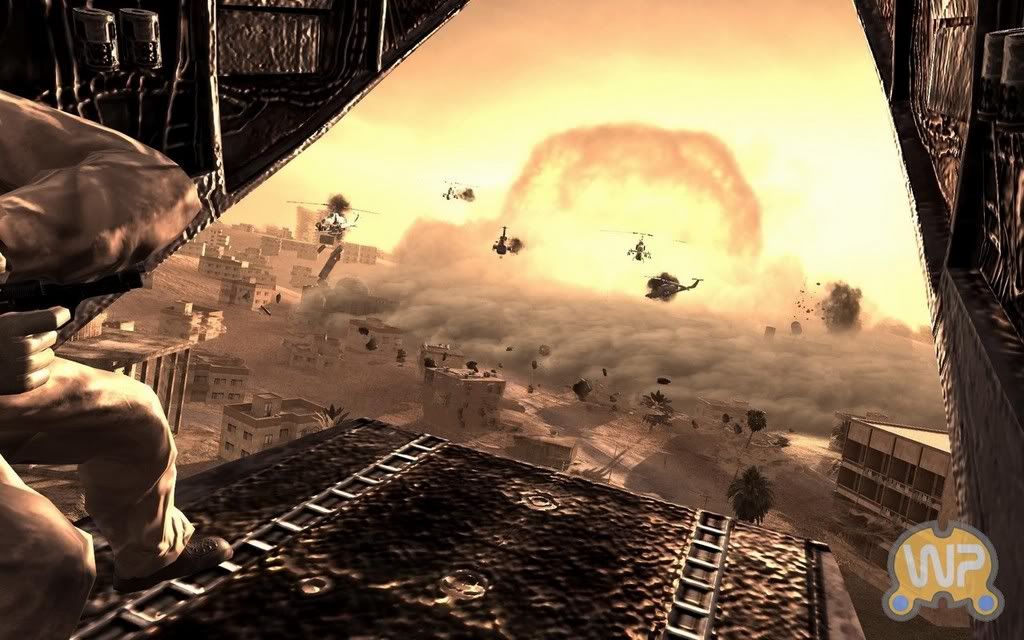
Multiplayer is the obvious focus for this fourth installment of Call of Duty, and to fully exploit every last challenge and rank you can expect to spend anywhere from 200-300 hours, or more. Much like you, the game only gets better the more you play it.
Final:
Call of Duty 4: Modern Combat is easily the best game in the history of the franchise, at least from a technical standpoint. I didn’t find it nearly as immersive or personally rewarding as I did the previous WWII games where I actually came away having learned something, but that is the risk you take when you abandon history and delve into fiction. Perhaps, someday, when the current events in Iraq are declassified, Infinity Ward can do something a bit more relevant with the genre.
Even so, Modern Combat is just about as perfect a game as you can get. It falls short of total perfection only because it really doesn’t evolve the FPS genre in any significant way – not that I know what that might be, but I’d know it if I saw it. It’s a must-own, must-play game for anyone (screw the ESRB) who owns a next-gen console or high-end PC.


Tech Info
As Space Pirate activity expands and Phazon begins infecting entire planets, Samus and the Federation set out to regain control of the region. But they soon discover that Phazon is more powerful than they ever realized. Each bounty hunter is overcome by the substance. Even Samus is corrupted. Thus closes the Prime trilogy, and in grand fashion.
Graphics :
Corruption is undoubtedly the most gorgeous Wii game available. Placed side-by-side with some of the visually best shooters on other systems, Corruption does not have the same level of crispness, but it holds its own through outstanding direction and intelligent artistic flares.
Space scenes, viewed in either cut sequences between planets or from vistas in playable areas, are breathtaking. Players are consistently reminded of the otherworldliness of the PVI9 universe, and each planet in that universe has a distinct yet varied feel. Elysia's floating city is unique in its relaxed openness, but dually sinister in its Metroid research labs. Bryyo presents the familiar, harsh motifs of fire and ice but set against a backdrop of a formerly intelligent and peaceful civilization. Vahalla starts as a quiet spaceship and evolves into an invaded stronghold and then a Metroid and Phazon dominated structure.
Small, clever visual cues create the true story as Samus continually morphs throughout the game. Her suit, only visible at select times, becomes overrun with the blue tint of Phazon. Her reflection, only visible while wearing the scan visor, slowly shows her corrupted state by the Phazon running across her face and through her veins. The effects are played up when they should be and kept in the background when appropriate. The camera angles are cinematic, the  visors remain spectacular, the arm cannon's energy and gravitational effects are stunning and the battles with Ridley are epic. Wonderful work.
Sound :
Sound is often overlooked, but Corruption makes full use of every human sense it is capable of affecting. The classic tunes remain, but each level is a blend of orchestral rock and Metroid riffs to craft a grand, space opera soundtrack. But it remains subdued, a background voice to each planet and space station. When the music subsides, the booms of Samus's arm cannon and the screech of the missiles blend into its own soundtrack, much like how the lightsabers' vibrations in The Empire Strikes Back created its own music. A few memorable scenes, particularly the early encounters with the Metroids, are as creepy as ever through sound alone.
It’s a grand accomplishment, without even mention of the high quality voice work, the first in the series to put a voice to the characters. In classic Nintendo fashion, the playable character has no dialog, a decision I've always liked. It keeps players in the role, rather than watching it.
Gameplay :
Super Mario 64 changed a genre not just through design, but through the control of the character in that design. The Remote/Nunchuck combo as implemented in Corruption does the same for the first person shooter and is the greatest control scheme the genre has seen on a console. The advanced setting is mandatory for the best experience as the aiming reticule is tied almost exactly to the motion of the remote, essentially using a minuscule bounding box to differentiate between aiming and head movement. Take the 10 minutes to adjust to the style and you will not be disappointed. Movement through any corridor is fluid, aiming is precise and dynamic and puts dual analog to shame.
The total immersion is what tips Corruption's controls beyond a keyboard and mouse. The simple task of removing a power cell from a wall is no longer a button push, but a reach in, grab it, and pull it out motion. That's your hand making it happen; it's surprisingly rewarding and used the right amount of time. The grapple beam's attachment to a flick of the Nunchuck works perfectly and is another batch of interactivity not found elsewhere. Similar interaction is used throughout play in different settings and adds a level of realism that graphics cannot.
Even without the controls, Corruption would be one sweet experience. In classic Metroid  tradition, players progress through multiple worlds, collecting upgrades that open additional areas to investigate. While the game is slightly more linear at first, Corruption's backtracking goodness and deep exploration expands overtime. The action is heavier than its predecessors, but not at the expense of the adventure elements as Corruption is the largest of the three games. The environmental puzzles are solid and satisfying, particularly the morph ball segments, which continue the excellent 3D transition. The maps take great advantage of every dimension while the change in the weapon system, with set stacked upgrades rather than beam choices, works better than expected and makes Corruption a streamlined experience.
The full story is still told mainly through scans, which I like as it lets players take it at their own pace. The corruption theme plays well during gameplay. Hypermode is an extremely powerful and destructive attack system that uses the corruption as a weapon, but its cost is an energy tank. Sometimes you can come out of Hypermode and recover some energy, but other times Phazon overloads Samus's suit, and the remaining Phazon must be expelled through a barrage of panicked blasts to avoid death. It's a love-hate relationship that keeps with the dark tone of the series, and plays out to its fullest in the games final act.
Multi :
The lack of multiplayer may be unfortunately to some, and I certainly expected online play to be a major selling point of Corruption, but the game stands on its own merit as an outstanding single player experience. From an artistic standpoint, the Prime trilogy is, perhaps, best closed without an online multiplayer addition. If you have a friend with the game, however, you can use each other to unlock extras like screenshot captures, which can be traded between consoles.
Final :
Accept these two realities: Wii's graphical firepower is below the capabilities of its rivals, but Wii's first-person controls are far beyond any other console. The trade is a bit of flash for a ton of feel, and it’s a good one. While most shooters transport players inside a character's head, Corruption throws players inside the entire suit by giving the complex Samus realistic controls.
And what Corruption lacks in available hardware specs it makes up for in direction and style for a truly beautiful game world. With creative creatures and a consistently brooding atmosphere, Samus's world is as alive and gorgeous as ever. It may not use the freshest paint, but it comes from the brush of a great painter, and together rivals Twilight Princess for the best Wii game yet.

Tech Info :
 impressive sales. And now there's Halo 3, which will undoubtedly sell through the roof. The title is the third and final installment in the Halo trilogy, which means it offers closure to the arcing storyline. In addition to its campaign mode, the game also supports Xbox Live multiplayer. Some will argue that Halo 3 is essentially "Halo 2 Plus," but few would disagree that it's superior to its predecessor in nearly every way possible.
 If you've ever played Halo 2 on Xbox Live, you know all about the annoyance that is push-to-talk. Well, apparently Bungie listened to all of our complaints – it's gone. Well, sort of. If you have four people on your team or less, you don't have to press the D-pad to talk to your friends. Hallelujah.
 for campaign mode.
 times, it feels like Halo 3 is simply the team's attempt at a "redo" of Halo 2.
 On the subject of Xbox Live co-op, many of our attempts at playing co-operatively online have been ruined by noticeable lag problems. The problem seems to come and go, and while we aren't docking points because of it (it'll likely be fixed via a patch in the future), at this point in time, the lag is an issue.
 Confusingly, Halo 3's load times seem to be some of the worst in the franchise. Whether you're playing in campaign or over Xbox Live, you'll have to wait for the game to load each level or map when you're in the menu. Then you'll have to wait again for it to actually load the level in-game. The load times just feel so long.
 This Zone Details >>>

Tech Info :
The sense of scale and clarity of the visuals are what impressed me the most about Resistance. Even on a standard definition set, the game looks good. On a HD set, it looks great as long as it is viewed at its native 720p resolution. My impressions of the game upscaled to 1080i weren’t good. There isn’t much variety among the different Chimera you face, but the designs are neat to look at. Nathan Hale, the main character, is one of the better looking player models I’ve seen in a game. You don’t seem him much, but the model (as well as other character models) is devoid of the fake, plastic look found in many next-generation character models.
One of my few visual nit-picks was the lack of consistent lighting and shadow. Some light sources showed off great lighting while others didn’t. Chalk this up to the visual scrutiny I mentioned earlier.
 Resistance’s soundtrack is the loud, booming orchestral stuff you’d expect to hear in epic war movies. There are times where it is barely noticeable, only to flourish when the action picks up. There isn’t much voicework in the game, but what is there is pretty good compared to the standards set by other games. I was really happy with weapon report, which have the impact other games lack.
It is really easy to want to compare Resistance to Halo, the current “standard” when it comes to console first-person shooters. And, while Resistance does stack up well to Halo, it actually shares more in common with another Insomniac game, Ratchet & Clank.
It is an odd comparison, but hear me out. Although the two are completely different genre-wise, Resistance features the same smart level design and attention to craft as Ratchet & Clank. Levels are very linear, but give the illusion that they are bigger than they really are. The effect doesn’t come off quite as good as it does in R&C, but levels still follow something of a progressive story from start to finish. Early on, this translates into lots of empty hallways connecting enemy-filled rooms, but later on things begin to open up a bit.
Layout and pacing is also similar. Health and ammo are placed in areas that just make logical sense. It is rare that you’ll go long without seeing at least one of either, yet there isn’t an overabundance of them. Early on, you gain the ability to heal one health bar, so you’re never left completely desperate. Instead, the regenerating bar simply gives you that little bit of lifeline you need to hopefully make it through to the next area. This also adds a small level of strategy to what would otherwise be a standard shooter. You’ll have to decide when to retreat and heal up during fights. It also makes cover a little more important since you’ll want to duck down and heal a bar before popping back up and shooting.
Although most of the game is played as a first-person shooter, there are also a few vehicle levels scattered around. These include tanks, Jeeps and a Chimeran walker that a lot like Deadlocked’s Landstalker. All handle really well and feel right. The Jeep is fast while the tank is slow. The only downside is that vehicle levels aren’t that common and, with the exception of a Jeep ride a third of the way through the game, aren’t that long.
As you progress through the single-player campaign, you can uncover files that offer backstory on the Chimera as well as completing a number of challenges that earn you skill points. These can later be spent on unlockables, like art galleries. The single-player game can be played through as a co-op campaign, completely changing the game’s dynamic. Unfortunately online co-op isn’t available, so not as many people will have a chance to experience it.
Resistance’s multiplayer side contains six different online game types. A variety of maps are available that support anywhere from 8 to 40 players. Game types include standards like Capture the Flag and Deathmatch, as well as a survival mode called Conversion, and Breach and Meltdown, where you defend points on a map. The online games I played were lag-free, though I was unable to find a 40-man game. This should pick up once more consoles are off eBay and available to players. Resistance offers clan support, as well as an in-game Friend List. You’ll also earn medals based on your performance during matches.
One of the neat things about multiplayer games is that you can choose to play as either the humans or Chimera. Each plays differently. Humans have access to an in-game radar and sprint ability while the Chimera can enter a “rage” mode where they become stronger, faster and gain the ability to see through walls. Both races seem balanced and teams switch sides between rounds, so if one does have an advantage, both teams have it.
 Difficulty:
 As you progress through the campaign, your progress is saved through checkpoints. Checkpoints aren’t all that common, but like health and ammo, are evenly spaced. You never feel like you’re being severely punished for dying. You’ll be thankful for this later in the game when it becomes much, much harder.
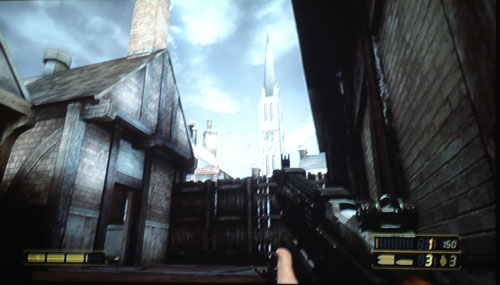
Once again drawing parallels with Ratchet & Clank, weapons are balanced. Weapons earned earlier in the game are just as useful as ones found later in the game and there are several times in the game where you’ll find yourself falling back on your machine gun not because you have to, but because it is the best weapon for the job.
Resistance follows the same basic control scheme as other console first-person shooters. The overall response is excellent, though once or twice I had the controller cut out on me. At one point, I kept moving even though I wasn’t pushing the analog stick and another time it shut down and gave me a “Please Connect Controller” message. This seems to be more of a hardware problem since I experienced the same thing while playing Untold Legends: Dark Kingdom.
It is also worth noting how Resistance uses the Sixaxis’ motion sensor. At points in the game, enemies will run up to you and grab you. If this happens, you can shake him off by shaking the controller.
Resistance: Fall of Man is something every first-person shooter fan should check out. It may not do many things differently, but what it does differently helps to make it stand out. If you’re still undecided on a launch title to go along with your PS3, Resistance: Fall of Man is your best bet.

Tech info :
The game takes place in London, naturally, and it's the near future. A large gate to hell--some might call it a "Hellgate" of some kind--has opened and demons have been spewing forth from it. The storyline has you, as a character in one of six classes, falling into an adventure that puts you on a path to seek out various oracles, kill a whole lot of demons, and eventually penetrate the Hellgate itself. But the storyline is rather limp. It's best conveyed by prerendered cutscenes that play out between each of the game's acts, but there are hours of often poorly written quest dialogue text and flat character exclamations between those cutscenes. The game can't seem to make up its mind as to whether or not it wants to be serious or funny, and the characters that have been placed in the game for comic relief don't work very well, with the possible exception of a guy who, through your actions, ends up having a small demon hump his face for the rest of the game. The game also has a handful of technical issues, including frame rates that randomly take a dive and hard lockups that, depending on when they occur, might make you play through a significant chunk of the game again.
This storyline plays out the same way whether you play offline or online, which essentially means that the offline mode is useless. The main point of this game is collecting loot and upgrading your character. Considering that you'll find a ton of loot that your character class can't use and that the most important part of tricking out your character is the ability to show it off to other people, there's no good reason to play offline.
The gameplay in Hellgate has you spending time in safe locations, usually train stations, where you'll take on quests, buy or sell items, and, if you're online, interact with other players. But there are a lot of different zones tying these stations together, and they're all filled with a variety of enemies for you to shoot or stab. How you attack depends on which character class you play. There are two melee classes, and these actually play out from a third-person, behind-the-back perspective, so you can see your sword and what you're cutting. The ranged classes, whether you're shooting guns or spells, work best from the first-person perspective (though you can pull out to third, if you want). Either way, playing the ranged class turns the game into a first-person shooter...but not a particularly great one because it's more RPG than action. You get the impression that when you aim your weapon at something and start firing, all you're doing is triggering some hidden series of dice rolls that determine how hard you hit. The weapons lack impact and you end up feeling really detached from the combat.
Of course, there's more to it than your basic attacks because each character class has a set of skills you can use. Marksmen can paint targets to make them take more damage, engineers can call out bots that do most of the heavy lifting in battle, evokers can cast various spells at enemies, and so on. As you gain levels, you earn more points to put into skills, but you need to be careful with how you spec out your character because there's currently no way to undo your choices. It's very possible to misspend your points and end up with a weaker-than-average character. Some similar games let you trade a chunk of in-game currency for the ability to reset your skills.
Much of Hellgate ends up feeling quite repetitive because you'll see most of the game's best tricks in the first few hours. The enemy designs look great, covering a wide range of imps, crawling demons, surprise-spawning beasts, and floating, ghostly images. But the game also reuses those same enemy designs repeatedly, using the old "let's change their name and their color" trick. The level designs look really nice at first as you explore train tunnels, torn-apart city streets, and hell itself. But the game's random level design just sort of cobbles together prefabricated pieces in slightly different ways as you play, and before too long, all of the combat zones just start to feel identical. At least they'll look quite good from a technical perspective, especially if you have a DirectX 10 setup, which allows you to turn on some really great-looking motion blur and depth of field effects.
Playing by yourself is relatively easy and fun, but even if you're playing online, you don't have to interact with other players at all. Online, though, you can party up with other players and go into combat together. This makes the game more interesting because the various class skills can work well together and the game gets tougher as you add more people to the mix. If you aren't good at socializing, you can check an "auto party" box, which attempts to automatically hook you up with other people when you enter a combat zone. Chatting in Hellgate can be tough because the interface isn't too great and there aren't too many natural breaks from combat while you're out fighting. The game also has a voice-chat option.
So what makes Hellgate worth playing? That's the craziest part. Hellgate: London is saddled with a variety of issues, yet it still manages to be totally addictive and compelling because it expertly handles one of gaming's oldest clichés: new stuff. New items and money are constantly popping out of enemies when you mow them down. Each item--even the ones that aren't suitable for your character class--is also useful in some way. You can, obviously, sell items back to any merchant in the game, but you can also break items down into base components that are the backbone of the game's crafting system. With a blueprint, some runic fragments, and a whole mess of rare tech boards, you can make new items. But you can also use those same items to upgrade your existing gear. When you find the exact type of rifle or a pair of pants with bonus stats that really help out your character, you can use these components to make sure the items remain useful as you (and your enemies) get tougher. This means you never really have to outgrow your gear, though you'll also find plenty of new, useful gear as you play.
Furthering the customization and upgrade aspect of the game, some weapons also have slots for weapon mods, such as different types of ammo, batteries, or fuel. These add properties to your weapons and can raise your accuracy, raise your attack power, add fire damage to your weapon, or make weapons cut through enemy shields. You can add mods for nothing, but you'll have to spend some of your in-game currency to remove them. You can also put any equippable item into a machine found in most stations and pay money to add effects to them. The catch is that you don't get to choose the effect; you just get to choose whether it's a common, rare, or legendary effect. So it's a risky gamble that can make your weapons insanely powerful, but it might end up giving you an effect that's only relevant to another class.
You also have to watch your character stats. Each time you level up, you're given five points to drop into accuracy, strength, stamina, and willpower. Most items have stat requirements, and those requirements stack. So if your pants require you to have five willpower points and your shoulders require three more, you'll need at least eight points in that stat to wear both. It's possible to upgrade a weapon to the point that you can't actually use it anymore, but the game doesn't warn you about this, which is supremely frustrating.
While you can certainly play the game online for free and experience most of what Hellgate has to offer, you can also subscribe for $10 a month. Right now, the main benefits for subscribers are access to a harder difficulty setting, more character slots, and more room to store gear. You also get to partake in various themed events. There have been two such events as of this writing, one based on Halloween and one based around Guy Fawkes Day. These events add a few quests, but their primary function so far seems to be adding a bunch of annoying little drops to the game, such as apples, potatoes, or blueprints, for pets and stuff. Considering you have limited inventory space, it all just gets a little overwhelming.
If you love hoarding stuff and don't mind repetition, Hellgate: London is a really neat but often uneven game that will probably keep you busy for at least a month or two, even if you don't subscribe. But, for many, the game's issues will be a real deal breaker. If you're on the fence, you might want to watch the game's patch notes to see how many technical glitches, as well as other annoyances, are cleared up.


